4 Strategies to Reduce Screen Time While Maintaining Effective Patient Documentation
Healthcare providers face a persistent challenge: completing thorough patient documentation without sacrificing face-to-face interaction time. This article presents four practical strategies that help clinicians reduce their screen dependence during patient visits while maintaining accurate medical records. Each approach is supported by insights from experienced healthcare professionals who have successfully implemented these methods in their own practices.
Adopt Voice Dictation Enhance Patient Focus
I rely on voice-assisted documentation during visits instead of typing continuously. I summarize key findings verbally into the system and finalize the note afterward, which allows me to maintain eye contact and stay focused on the conversation rather than the computer. It keeps the visit feeling natural and helps me capture important details without interrupting the flow.
This has noticeably improved my patient relationships. Patients feel more listened to and less rushed when I'm not looking at a screen, which builds trust and leads to more open discussions about their concerns. Research from the American Academy of Family Physicians supports that strategies like dictation and workflow optimization reduce EHR burden while preserving clinician-patient connection and visit quality.

Use Bookend Documentation and Shared Agenda
One strategy I've implemented is "bookend charting" with a shared agenda, meaning I do most of the documentation either right before I enter the room (reviewing key points and prepping templates) or immediately after the visit, so I can keep the screen time minimal while we're actually talking.
During the visit, I'll usually say something like, "I'm going to keep my attention on you and only jot down the essentials, then I'll finish the detailed notes right after." If I do need to type, I use it intentionally by narrating what I'm doing, such as, "I'm just documenting your symptoms so I don't miss anything important." That keeps the technology from feeling like a barrier and helps the patient feel included rather than ignored.
It's had a noticeably positive impact on patient relationships. People tend to open up more when they feel fully seen, and the session feels calmer and more human. I also find there's less repetition and fewer misunderstandings because the conversation flows better and patients are more engaged. Overall, it builds trust because the patient experiences the interaction as a relationship first, and documentation second.

Implement AI Scribe Improve Presence
How have you reduced screen time while still documenting effectively?
In the emergency room, we implemented Cleo, an AI scribe that listens to the patient encounter and generates documentation in real time. The difference was immediate and significant.
Before AI scribing, I'd spend half the encounter typing into a computer with my back to the patient, or I'd finish my shift and spend another hour catching up on charts. Neither option was good—one hurt the patient relationship, the other hurt me.
Now I walk into a room, sit down, and actually look at my patient while we talk. The AI captures the conversation, generates a note, and I review and sign it. Documentation that used to take 5-10 minutes per patient takes 1-2 minutes of review.
The effect on patient relationships has been profound. Patients notice when you're present versus when you're distracted by a screen. Eye contact, body language, the ability to actually listen—these things matter, especially when someone is scared or in pain. I've had patients comment that I "actually listened" to them, which is sad because that should be baseline, not exceptional.
The other benefit is cognitive. When I'm not mentally juggling documentation while trying to assess a patient, I'm a better clinician. I catch things I might have missed. I ask better follow-up questions. The quality of care improves, not just the patient experience.
AI scribing isn't perfect—you still need to review everything for accuracy. But it's the closest thing I've found to practicing medicine the way it should be practiced: focused on the patient, not the computer.
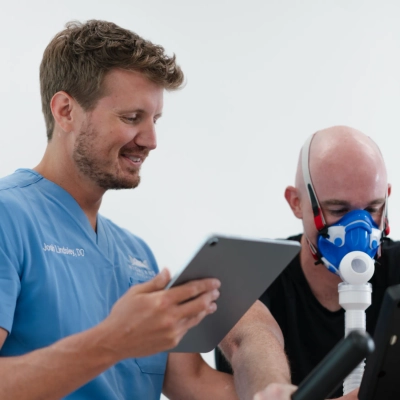
Joshua Lindsley, DO | Board-Certified Emergency & Obesity Medicine
Highland Longevity | Fort Worth, TX
www.highlandlongevity.com
Prioritize Eye Level Via SmartTexts
I make it a priority, especially for new patient visits, to sit on eye level with the patients and create a personal connection. Asking about their hobbies, family, job, and more can create a sense of personal investment into the overall wellbeing of the patient. Once we create that rapport, I start taking notes into the EMR while still maintaining eye contact. The most efficient tool for me has been creating SmartTexts and using SmartTools on Epic to expedite documentation while still maintaining thorough clinical care and patient rapport. Sitting with patients, facing towards them while still being able to type via preset documentation tools (like SmartText on Epic) is pivotal for establishing an efficient yet effective clinical workflow.